
Flatbed vs Wheel-Lift Towing Which Is Better for Your Car? (2025 Guide)
Flatbed vs wheel-lift towing is one of the most important decisions when your car breaks down in Toronto and choosing the wrong method can cost you thousands. And it matters more than most people realise. Use the wrong towing method on the wrong vehicle, and you could walk away from a simple breakdown with a damaged transmission, a wrecked drivetrain, or suspension problems all completely avoidable with the right choice.
This guide explains exactly how each towing method works, the pros and cons of both, which vehicles need which method, and how to make sure the tow truck that shows up in Toronto is using the right equipment for your car.
How Flatbed Towing Works
A flatbed tow truck also called a rollback has a long, hydraulically operated platform on the back. When loading a vehicle, the entire bed tilts backward and slides down until the rear edge meets the ground. Your car is then either driven onto the platform under its own power (if driveable) or winched up with a cable.
Once the vehicle is fully on the bed, all four wheels are completely off the ground. The car is secured with wheel straps the modern preferred method or chains, and the bed tilts back to a flat, level position for transport.
The result: your vehicle travels like cargo. It has no contact with the road surface, the drivetrain is not spinning, and there is no stress on the suspension, tires, or transmission during the tow.
How Wheel-Lift Towing Works
A wheel-lift tow truck uses a hydraulic boom with a metal yoke (a U-shaped cradle) that slides under either the front or rear wheels of your vehicle. Those wheels are lifted off the ground while the other two wheels remain in contact with the road and roll freely during the tow.
The key decision in wheel-lift towing is which end gets lifted and this depends entirely on your vehicle’s drivetrain:
- Front-wheel drive (FWD): Lift the front wheels. The rear wheels roll freely without engaging the drivetrain.
- Rear-wheel drive (RWD): Lift the rear wheels. The front wheels roll freely.
- All-wheel drive (AWD) or 4WD: Wheel-lift towing is generally not safe see below.
Wheel-lift trucks are smaller, faster to set up, more manoeuvrable in tight spaces, and typically slightly less expensive than flatbeds.
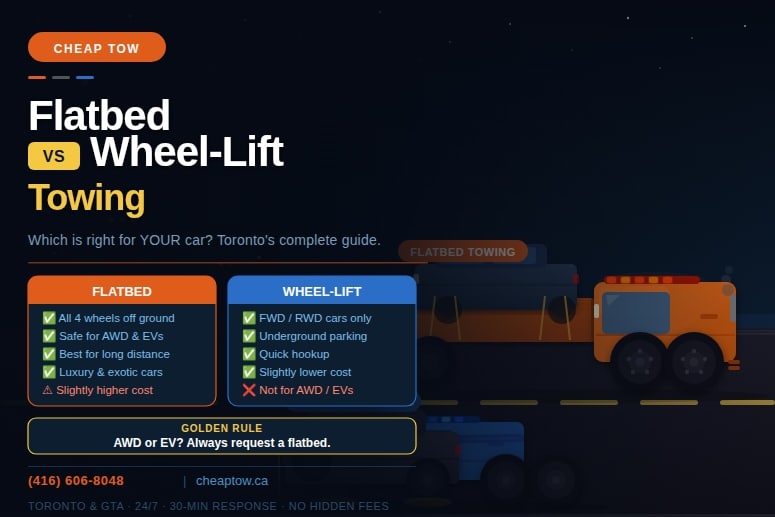
Flatbed vs Wheel-Lift Towing: Full Side-by-Side Comparison
| Flatbed | Wheel-Lift | |
|---|---|---|
| All four wheels off ground | ✅ Yes | ❌ No 2 wheels roll |
| Safe for AWD/4WD vehicles | ✅ Yes | ❌ No |
| Safe for EVs and hybrids | ✅ Yes | ❌ No |
| Safe for luxury/exotic cars | ✅ Yes | ⚠️ Risky |
| Works in underground parking | ❌ Often too tall | ✅ Yes |
| Best for long-distance towing | ✅ Yes | ⚠️ Short distances only |
| Loading time | Slightly longer | Faster |
| Cost | Slightly higher | Slightly lower |
| Risk of drivetrain damage | Very low | Possible if mismatched |
| Works for motorcycles | ✅ With attachment | ❌ No |
The flatbed vs wheel-lift towing decision affects every Toronto driver here is how to make the right call for your specific vehicle.
When Flatbed Towing Is the Right Choice
All-Wheel Drive and 4WD Vehicles
This is the most critical rule in towing, and the one most commonly misunderstood. If your vehicle has all-wheel drive or four-wheel drive, it must be flatbedded.
Here is why: in an AWD system, all four wheels are mechanically connected through the drivetrain. When a wheel-lift tow truck lifts the rear wheels and the front wheels roll on the road, the driveshaft continues to rotate but without lubrication from the engine-driven oil pump. The result is rapid, severe damage to the centre differential, transfer case, and transmission.
The repair bill for AWD drivetrain damage caused by improper towing routinely runs between $3,000 and $5,000 or more. That is never worth saving $30–$50 on a flatbed surcharge.
In the flatbed vs wheel-lift towing debate, AWD vehicles have no debate flatbed is the only safe option, full stop.
Common AWD vehicles in Toronto that must always be flatbedded:
- Subaru Outback, Forester, Crosstrek (all models all Subarus are AWD)
- Audi Quattro models
- Honda CR-V, Pilot, Passport (AWD variants)
- Toyota RAV4, Highlander, Venza (AWD variants)
- Ford Explorer, Edge (AWD variants)
- Jeep Grand Cherokee (AWD)
- Most modern SUVs with AWD badges
If in doubt, tell the dispatcher your vehicle is AWD and request a flatbed.
Electric Vehicles and Hybrids
Electric vehicles must always be transported on a flatbed no exceptions. Rolling an EV’s wheels during a tow causes the electric motors (which double as generators during regenerative braking) to generate electricity. That electricity has nowhere to go when the vehicle is off, which can overload the motor controllers, damage the battery management system, and void your warranty.
For electric vehicles, the flatbed vs wheel-lift towing question is settled all EV manufacturers require flatbed transport without exception.
This applies to:
- Tesla Model 3, Model Y, Model S, Model X
- Chevrolet Bolt
- Hyundai Ioniq 5 and 6
- Kia EV6
- Ford Mustang Mach-E
- Toyota Prius (plug-in hybrid)
- Any vehicle labelled BEV, PHEV, or hybrid
Luxury, Exotic, and Classic Cars
For high-value vehicles, flatbed towing is the only sensible choice not because wheel-lift would necessarily damage the drivetrain, but because of the additional risks:
- Low-clearance body kits, front splitters, and side skirts can be scraped or cracked by the wheel-lift yoke
- Road debris kicked up during the tow can damage bodywork
- Precise alignment and suspension settings can be disturbed by the stress of two wheels rolling
- Insurance claims on luxury vehicles are complicated using the wrong tow method can complicate coverage
Vehicles like Mercedes, BMW, Porsche, Ferrari, Lexus, Maserati, and any classic or restored car should always travel on a flatbed.
Severely Damaged Vehicles
If your car has been in a collision and has front or rear impact damage, damaged steering, a flat tire that has come off the rim, or any suspension damage, wheel-lift towing can make things significantly worse. A flatbed bypasses all of these concerns by simply lifting the entire vehicle off the ground in its current state.
Long-Distance Towing
The longer the tow, the more wear accumulates on the two rolling wheels in a wheel-lift setup. For any tow over 25–30 kilometres, a flatbed is the safer and more sensible option regardless of vehicle type. The additional stability over highways especially on Ontario’s 400-series roads also reduces the risk of the vehicle shifting during transport.
When Wheel-Lift Towing Is Perfectly Fine
Wheel-lift towing is not inferior it simply has the right use cases. For the correct vehicle in the correct situation, it is efficient, professional, and completely safe.
Standard Front-Wheel Drive Vehicles Over Short Distances
The vast majority of everyday Toronto commuter cars are front-wheel drive: Honda Civic, Toyota Corolla, Mazda3, Hyundai Elantra, Kia Forte, Chevrolet Cruze, Ford Focus, and so on. For these vehicles on a short-distance tow say, from a breakdown on Yonge Street to a nearby mechanic a wheel-lift truck does the job safely, arrives faster, and costs a bit less.
The front wheels are lifted, the rear wheels roll freely, and the transmission is completely unaffected.
Underground Parking and Tight Spaces
This is where wheel-lift trucks genuinely outperform flatbeds. A flatbed tow truck typically stands 2.4–2.7 metres tall and cannot enter most underground parkades in Toronto’s downtown core. Cheap Tow’s wheel-lift trucks are built to fit the standard underground parking height of 2.0–2.1 metres which is why we regularly recover vehicles from underground lots in buildings all across the city.
If your car is broken down in an underground garage, a wheel-lift truck is almost always the right tool.
Quick Roadside Clearance
On a busy street during peak hours, a wheel-lift truck can hook up and move a vehicle in under five minutes. A flatbed requires the driver to position the truck, lower the bed, winch the vehicle up, secure it, and raise the bed a process that takes longer and requires more clear road space. For situations where traffic clearance is urgent, a wheel-lift may be dispatched first.
Rear-Wheel Drive Vehicles
Classic rear-wheel drive vehicles older BMWs, Mustangs, some trucks, older Mercedes can be safely wheel-lifted from the rear on short tows. The front wheels roll freely and the rear drivetrain is stationary.
The Most Expensive Towing Mistake Toronto Drivers Make
The single most costly towing error we see is an AWD vehicle being towed with a wheel-lift often because the driver didn’t mention it was AWD, or the tow company dispatched the wrong truck.
Here is how to prevent it:
When you call for a tow, always say:
- The make, model, and year of your vehicle
- Whether it is AWD, 4WD, FWD, or RWD (check your badge, manual, or Google your exact model)
- Whether it is electric, hybrid, or has a manual transmission
- Whether any wheels are flat or the vehicle has collision damage
This 30-second conversation determines which truck gets sent and prevents thousands of dollars in preventable damage.
What About Hook-and-Chain Towing?
You may have seen older tow trucks that use chains wrapped around the vehicle’s frame or axle. This method once the industry standard is now largely obsolete for passenger vehicles. It risks frame damage, scratches, and is particularly harsh on modern unibody vehicle construction. Reputable towing companies in Toronto use wheel-lift or flatbed equipment exclusively for passenger vehicles.
If a company shows up with hook-and-chain equipment for your car, it is reasonable to ask them to wait while you call a different service.
Flatbed vs Wheel-Lift Towing Cost in Toronto
The price difference between the two methods is smaller than most people expect:
| Method | Typical surcharge over base rate |
|---|---|
| Wheel-lift (standard) | Base rate no surcharge |
| Flatbed | Add $25–$60 depending on vehicle |
At Cheap Tow, we always dispatch the correct truck for your vehicle type. If your vehicle needs a flatbed, we send a flatbed and we tell you the price before we hook anything up. No surprises.
For context: the flatbed surcharge on a typical Toronto tow runs $25–$60. The cost to repair AWD drivetrain damage from an improper wheel-lift tow runs $3,000–$5,000. The math is straightforward.
Quick Reference: Which Towing Method Does Your Car Need?
Always flatbed:
- Any AWD or 4WD vehicle
- Any electric vehicle (BEV) or plug-in hybrid (PHEV)
- Luxury or exotic vehicles (BMW, Mercedes, Porsche, Tesla, Lexus, Audi, etc.)
- Motorcycles
- Vehicles with collision damage or flat tires
- Any tow over 30 km
- Manual transmission vehicles (transmission must be in neutral; flatbed is safer)
- Lowered vehicles or cars with body kits
Wheel-lift is fine:
- Standard FWD sedans and hatchbacks (Civic, Corolla, Elantra, etc.) on short tows
- RWD vehicles towed from the rear on short tows
- Vehicles in underground parking or tight spaces
- Situations requiring fast hookup and clearance
Understanding flatbed vs wheel-lift towing helps you confirm the right truck is coming a 30-second conversation with the dispatcher is all it takes.
When unsure: tell the dispatcher your make, model, and drivetrain and let them decide. A good towing company will always send the right truck.
Why Cheap Tow Has Both and Uses Each Correctly
At Cheap Tow Toronto, our fleet includes both flatbed and wheel-lift trucks. Our dispatchers ask the right questions when you call make, model, drivetrain, condition so the correct equipment arrives the first time.
When you call Cheap Tow, you never need to worry about flatbed vs wheel-lift towing we ask the right questions and send the right truck every time.
We serve all of Toronto and the GTA including Scarborough, North York, Etobicoke, Mississauga, Brampton, Pickering, Ajax, Whitby, and Oshawa. Our trucks are underground-parking capable for wheel-lift jobs downtown, and our flatbeds handle everything from EVs to motorcycles to highway recoveries.
Call Cheap Tow 24/7: (416) 606-8048 Response in 30 minutes or less. Transparent pricing before we touch your vehicle.
Frequently Asked Questions
Is flatbed vs wheel-lift towing always better or does it depend on the car? Flatbed is safer for a wider range of vehicles, but wheel-lift is perfectly appropriate for standard front-wheel drive or rear-wheel drive cars on short distances. The best method depends on your vehicle’s drivetrain, value, and the distance being towed.
Can an AWD car be wheel-lift towed with dollies? Some operators carry wheel dollies that can be placed under the rolling wheels to lift all four off the ground during a wheel-lift tow. This is an acceptable method for short distances when a flatbed is genuinely unavailable but a flatbed is always preferable for AWD vehicles.
Does flatbed towing cost more in Toronto? Yes, typically $25–$60 more than a standard wheel-lift tow. For most vehicles that require a flatbed, this cost difference is minor compared to the protection it provides.
Can a Subaru be towed with a wheel-lift? No. All Subaru vehicles use Symmetrical All-Wheel Drive. Towing any Subaru with a wheel-lift even for a short distance risks serious drivetrain damage. Always request a flatbed for any Subaru.
What happens if my electric vehicle is wheel-lift towed? The electric motors generate electricity as the wheels roll, which can damage motor controllers, the battery management system, and regenerative braking components. All EV manufacturers including Tesla explicitly state their vehicles must be transported on a flatbed.
How do I know if my car is AWD, FWD, or RWD? Check the badges on your vehicle (AWD, 4WD, Quattro, xDrive, SH-AWD, e-AWD are all AWD indicators), check your owner’s manual, or Google your exact make, model, year, and trim. When in doubt, tell your tow company you think it may be AWD and let them confirm.
Cheap Tow is a 24/7 towing and roadside assistance company serving Toronto and the Greater Toronto Area. We operate both flatbed and wheel-lift trucks and always dispatch the correct equipment for your vehicle. Call (416) 606-8048 30-minute response, no hidden fees.