
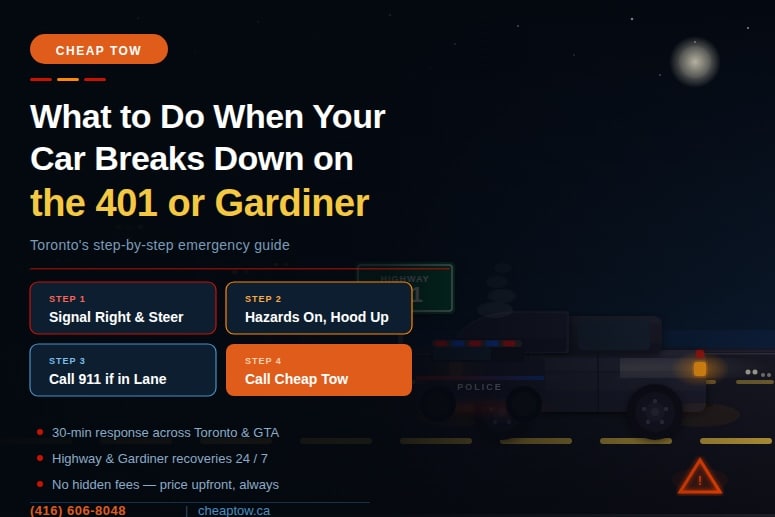
What to Do When Your Car Breaks Down on the 401 or Gardiner Expressway in Toronto
Every driver dreads the moment their car breaks down on 401 Toronto highways, but knowing what to do makes all the difference.
If your car breaks down on 401 Toronto highways or the Gardiner Expressway, the next 60 seconds are critical, here is exactly what to do.
Breaking down on the 401 or the Gardiner Expressway in Toronto is one of the most stressful driving situations you can face. These aren’t quiet side streets, they’re high-speed, high-traffic corridors where the wrong move can put your life at serious risk. Knowing exactly what to do when your car breaks down on the 401 or Gardiner before it happens to you could make all the difference.
This step-by-step guide walks you through everything: how to get safely off the road, what to do while you wait, who to call, and how to avoid the costly mistakes most Toronto drivers make in this situation.
Why the 401 and Gardiner Are Particularly Dangerous for Breakdowns
Highway 401 through Toronto is one of the busiest highways in North America. During peak hours, over 500,000 vehicles use sections of it daily. The Gardiner Expressway, while shorter, carries over 200,000 vehicles per day through the heart of downtown, with tight lanes, limited shoulders, and nowhere to go if something goes wrong.
A breakdown on either road means:
- Traffic passing at 80–120 km/h just feet from your vehicle
- Limited or no shoulder on parts of the Gardiner Expressway
- High risk of secondary collisions if your car is in a lane
- Potential $490–$2,000 fines if emergency vehicles can’t get through
Seconds matter. Having a clear plan means you act on instinct rather than panic.
Step 1: Don’t Brake Suddenly – Signal and Steer to Safety
The moment you feel your car losing power, misfiring, or overheating, resist the urge to brake hard. Sudden braking on a highway is one of the most common causes of secondary rear-end collisions.
Instead:
- Take your foot off the gas and let the car slow naturally
- Turn on your hazard lights immediately – do this before anything else, even before you decide where to go
- Check your mirrors for a gap in traffic
- Signal right and begin moving toward the right shoulder as smoothly as possible
- Use whatever momentum you have – even a dying car can coast further than you think
If your steering and brakes feel stiff (which happens when the engine cuts out), don’t panic. Power steering and power brakes still work – they just require more effort. Keep both hands on the wheel and maintain a straight line.
What to do on the Gardiner specifically
The Gardiner Expressway is elevated and has very narrow or no shoulders in some sections – particularly between the DVP interchange and Spadina Avenue. If you cannot reach a shoulder:
- Get as far right as possible, as close to the concrete barrier as you safely can
- Keep your hazard lights on
- Do not attempt to exit the vehicle into moving traffic
- Call 911 – on the Gardiner, being stuck in a lane is a genuine emergency
Step 2: Get as Far Off the Road as Possible
Once you’ve steered right, your goal is to get the vehicle completely off the travel lanes. On the 401, this typically means pulling onto the right shoulder. On the Gardiner, look for any widening, an on-ramp area, or the nearest exit.
If you can roll far enough, aim for:
- A highway exit ramp – far safer than the shoulder, gives you much more room
- A rest stop or service area (on the 401 in the outer GTA sections)
- The right shoulder, as far from the white line as possible
Do not stop at an angle. Get your vehicle parallel to the road and as close to the right barrier or edge as possible. A vehicle sitting at an angle sticks further into the road and is significantly more dangerous.
When your car breaks down on 401 Toronto, your only goal is to reach the right shoulder before momentum runs out.
Step 3: Exit the Vehicle Safely – or Stay Inside
Once stopped, you face a critical decision: get out or stay in. The answer depends on where you are.
Stay in the vehicle if:
- You are on the Gardiner with no shoulder and traffic is close
- You are on the 401 in a high-traffic section during rush hour
- You cannot put safe distance between yourself and moving traffic
- The weather is poor (ice, heavy rain, low visibility)
In these situations, keep your seatbelt on, stay low in your seat, and call for help from inside the car. A seatbelt will protect you far better than standing outside if a distracted driver hits your vehicle.
Exit the vehicle if:
- You are fully on a wide shoulder with significant distance from traffic
- The vehicle is smoking or you smell burning – fire risk means you must get out
- You can exit safely on the passenger side (away from traffic)
Always exit from the passenger side if at all possible. Opening a driver’s door into a highway lane is one of the most dangerous things you can do in this situation.
Once out, immediately move up the embankment or behind the barrier – never stand behind or beside your vehicle where another car could push it into you.
Step 4: Make Your Vehicle as Visible as Possible
Your hazard lights are already on. Now maximise visibility further:
- Pop the hood – the universal distress signal that tells other drivers your car has broken down (not just parked)
- Place road flares or reflective triangles at least 30 metres behind your vehicle if you carry them. On a 100 km/h highway, this gives approaching drivers about 1 second of additional reaction time per 10 metres of warning distance
- Tie something bright to your antenna or door handle – a white cloth, jacket, or even a plastic bag signals distress to passing OPP cruisers
- Leave your interior dome light on if it’s dark or overcast
Do not use your phone’s flashlight as a signal – it can confuse or distract drivers approaching at speed.
Step 5: What to Do When Your Car Breaks Down on 401, Who to Call
Call 911 if:
Knowing who to call when your car breaks down on 401 Toronto roads or the Gardiner can save you time, money, and serious danger.
- You are stuck in a live lane with traffic passing your vehicle
- Anyone is injured
- Your vehicle is smoking or on fire
- You are on the Gardiner with no shoulder
- You feel unsafe or threatened
The OPP and Toronto Police monitor both the 401 and Gardiner and can dispatch assistance quickly. They can also manage traffic to create a safer buffer around your vehicle.
Call a tow truck next:
Once you’ve assessed that you are safe, or immediately after calling 911 if the situation permits, call a tow truck. For Toronto highways, you want someone who:
- Responds quickly – every minute on the 401 or Gardiner shoulder is a risk
- Has experience with highway recoveries and ramp access on the Gardiner
- Can reach you within 30 minutes
Cheap Tow: (416) 606-8048 – available 24/7, 30-minute response across Toronto and the GTA, experienced in highway and expressway recoveries.
Important: Under Ontario’s Towing and Storage Safety and Enforcement Act (TSSEA), you have the right to choose your own towing company. If an unsolicited tow truck shows up at your breakdown – and this happens frequently on the 401 – you are not required to use their service. You also have the legal right to a written price estimate before any towing begins.
Call your insurance company after:
Most Ontario auto insurance policies include roadside assistance coverage. Call your insurer once you’ve secured a tow – they may cover part or all of the cost. Do not wait for the insurance company before calling a tow truck; your safety comes first.
Step 6: While You Wait – Stay Safe
The wait for a tow on a Toronto highway can feel very long. Use this time wisely and safely:
Do:
- Stay behind the barrier or up the embankment – not near your car
- Keep your hazard lights running (they’re visible from much further than you think)
- Monitor your surroundings and stay alert to approaching vehicles
- Stay on the phone with 911 if you feel unsafe
- Keep children and pets with you at all times – not in the vehicle
Don’t:
- Stand behind your vehicle to look at what’s wrong
- Attempt roadside repairs in a live shoulder – this is not the place to change a tire unless you have no other option and have maximum visibility
- Walk along the highway to an exit ramp – this is extremely dangerous
- Accept a ride from a stranger unless you feel genuinely threatened
What Happens When OPP or Toronto Police Arrive
OPP officers patrol Highway 401 regularly and are trained to assist stranded motorists. When they arrive, they will:
- Park their cruiser behind your vehicle with lights on to create a buffer zone
- Assess the situation and your safety
- Call for a tow if one hasn’t been dispatched – note that police-dispatched tow trucks are not necessarily cheaper or better than calling your own. You can decline their tow truck suggestion.
- Issue traffic control if needed
Toronto Police handle the Gardiner Expressway, which falls within the City of Toronto’s jurisdiction. Response times on the Gardiner are generally fast given the proximity to downtown stations.
The Move Over Law – What Other Drivers Are Required to Do for You
Once you’re safely on the shoulder with your hazard lights on, Ontario’s Move Over Law (Section 159 of the Highway Traffic Act) protects you. Any driver approaching your stopped vehicle with hazard lights flashing is legally required to:
- Move over one lane away from you if it’s safe to do so
- Slow down and proceed with caution if moving over isn’t possible
This law also applies to tow trucks once they arrive, passing drivers must move over and slow for any tow truck with amber flashing lights stopped on the highway. Failure to comply carries fines of $490 to $2,000 and three demerit points for a first offence.
Common Mistakes Toronto Drivers Make During Highway Breakdowns
Mistake 1: Braking suddenly. The natural instinct is to hit the brakes. On a highway, this can cause a rear-end pile-up. Ease off the gas, signal, and steer.
Mistake 2: Stopping in the middle lane. If you have any momentum left, use it to reach the right shoulder. A car stopped in a centre lane is extremely dangerous.
Mistake 3: Standing behind the vehicle. Hundreds of tow truck drivers and roadside workers are struck from behind every year. Never stand between your car and approaching traffic.
Mistake 4: Trying to change a tire on the 401 shoulder. Unless your situation is truly desperate, wait for a professional. The shoulder of the 401 during rush hour is not a safe workspace.
Mistake 5: Accepting an unsolicited tow. Predatory towing is a real issue in Toronto. Tow trucks that show up uninvited at breakdown scenes have been known to charge inflated rates and take vehicles to expensive storage lots. Under Ontario law, you can always say no and call the company of your choice.
Mistake 6: Walking along the highway. No matter how far the exit looks, walking along the 401 or the Gardiner is illegal and extremely dangerous. Stay with your vehicle.
Special Situations on the Gardiner Expressway
The Gardiner presents unique challenges that don’t exist on the 401:
No shoulder in some sections. Between roughly Spadina Avenue and the DVP interchange, the Gardiner has minimal or no usable shoulder. If your car dies here, call 911 immediately and stay in the vehicle.
Elevated structure. There is no easy escape route on foot. Stay put and wait for official assistance.
Ramp access. The Gardiner has frequent on and off-ramps. If you have enough momentum, targeting an exit ramp gives you far more space and safety than the expressway itself.
Construction zones. The Gardiner has been under ongoing maintenance and repair. Construction zones reduce already-tight lanes further be especially cautious and call for help quickly if you break down in or near a work zone.
What to Keep in Your Car for Toronto Highway Emergencies
Being prepared dramatically reduces the risk of a bad highway breakdown:
- Roadside emergency kit flares or LED triangles, jumper cables, reflective vest
- Phone charger / power bank you need your phone working to call for help
- CAA card or towing company number saved in your phone don’t search for a tow truck from the shoulder
- Warm blanket critical in Ontario winters when waits can be long
- First aid kit
- A printed note with your insurance company’s roadside assistance number
Save Cheap Tow’s number right now: (416) 606-8048. Available 24/7. If you break down on the 401 or Gardiner, one call gets a truck to you in 30 minutes or less no hidden fees, transparent pricing before we hook up your vehicle.
How Much Does a Tow from the 401 or Gardiner Cost?
Towing from a Toronto highway is typically priced the same as any other tow base fee plus distance. What you’re paying for is fast response and the equipment to safely handle a highway recovery.
At Cheap Tow, a typical tow from the 401 or Gardiner to a Toronto mechanic or your home runs:
- Short distance (under 15 km): $90–$140
- Medium distance (15–30 km): $140–$220
- Long distance or AWD/EV flatbed towing: $220–$350+
We always give you the price before we hook up your vehicle. No surprises.
When your car breaks down on 401 Toronto or the Gardiner, response time matters, Cheap Tow reaches you in 30 minutes or less.
Frequently Asked Questions
What is the first thing to do when my car breaks down on 401 Toronto? Turn on your hazard lights immediately, ease off the gas, and steer smoothly to the right shoulder. Signal your intentions early so traffic behind you has time to react. Once stopped safely, call 911 if you’re in a lane, then call a tow truck.
Is it safe to stay in my car on the Gardiner Expressway? In many cases, yes especially if there is no shoulder. Keep your seatbelt on, stay low, and call 911. The Gardiner has sections with no usable shoulder where exiting the vehicle into traffic is more dangerous than staying inside.
Do I have to use the tow truck the police call for me? No. Under Ontario’s TSSEA regulations, you have the right to choose your own towing company. If you have a preferred company, tell the officer and call them directly.
Can I change my tire on the 401 shoulder? It is technically possible but strongly not recommended during heavy traffic. If you must, turn on all hazard lights, place warning triangles behind the vehicle, wear bright clothing, work as quickly as possible, and have someone watch for approaching vehicles. Better to wait for a professional.
How long will a tow truck take to reach me on the 401 or Gardiner? With Cheap Tow, response time is 30 minutes or less across Toronto and the GTA. Highway access varies by location we know the 401 interchange access points and the Gardiner ramps and will reach you as fast as any company in the city.
What does the Move Over Law mean for me while I’m broken down? While you’re stopped with hazard lights on, other drivers are legally required to move one lane away from you and slow down. This gives you some protection on the shoulder but don’t rely on it. Assume not every driver will comply and stay as far from traffic as possible.
Cheap Tow is a 24/7 towing and roadside assistance company serving Toronto and the Greater Toronto Area. We handle highway recoveries on the 401, the Gardiner, the DVP, and the QEW. Call us any time: (416) 606-8048. Response in 30 minutes or less guaranteed.
Every year, thousands of Toronto drivers face the moment their car breaks down on 401 or Gardiner, most are unprepared.
Whether your car breaks down on 401 Toronto during rush hour or midnight, Cheap Tow is available 24/7, call (416) 606-8048.